
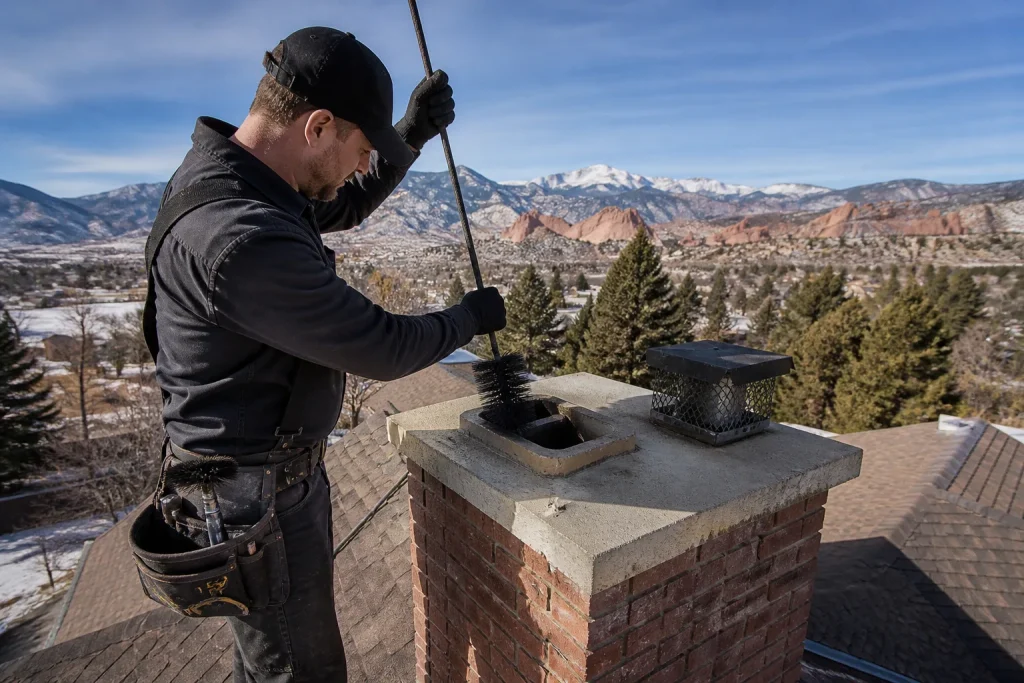
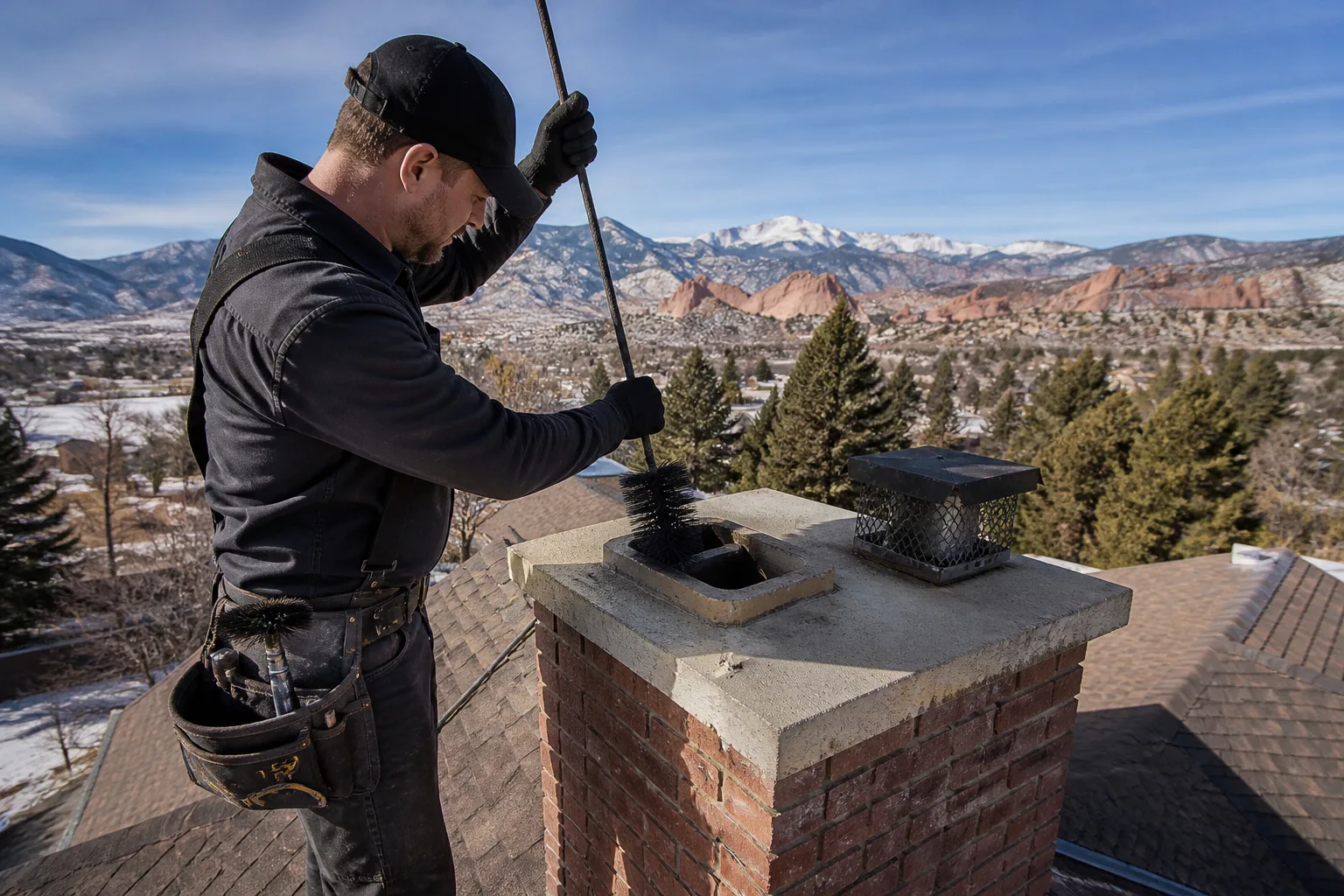
How to Choose the Right Chimney Cleaning Company in Colorado Springs
The right chimney cleaning company in Colorado Springs is one that can prove its credentials, document what it finds in writing, and fix what it discovers without handing you off to a second contractor. Most homeowners choose on price alone, and that’s exactly how a maintenance appointment turns into a liability. If you’d rather skip the guesswork and talk to someone who can diagnose and repair in the same visit, call (844) 560-6330. We answer 24/7. Fast dispatch from 7am to 7pm, Sunday through Friday.
Here’s the honest truth about this market: any crew with a brush and a shop vac can print “chimney sweep” on the side of a truck. The gap between a certified, inspection-grade operation and a pressure-washing business that added chimney work to its flyer is wide, and it matters most after the inspection, when something needs fixing.
What credentials should you verify before booking a chimney sweep in Colorado Springs?
Start with CSIA certification, then ask what the technician is actually certified to assess. CSIA certification is the floor, not the ceiling. It confirms a technician has been tested on sweeping and inspection fundamentals, but it doesn’t automatically mean they can diagnose a failing liner or write a report your insurer will accept.
Here’s what each credential covers in practice:
- CSIA (Chimney Safety Institute of America): Certifies the technician on chimney sweeping and inspection standards. Ask for the individual technician’s certification, not just the company’s membership claim.
- NFI (National Fireplace Institute): Certifies technicians on venting and appliance installation for specific fuel types. This matters if you have a gas or pellet appliance, not just a wood fireplace.
- Written inspection documentation: The credential is only half the story. What a company can legally put in writing, with photos and a described condition of the flue, crown, and damper, is what protects you.
Ask directly: “Can I see the certification of the technician who will be on my roof?” A company that hesitates, or that names a certification but can’t produce the technician’s card, is telling you something. In Colorado Springs, where fireplace use runs hard from fall through spring, that question separates a maintenance appointment from a gamble.
Why does repair capability matter when you’re only booking a cleaning?
Because a crew that can only clean has no incentive to look closely at what it can’t fix. When a sweep operation finds a cracked crown or a deteriorated liner, its only options are to mention it vaguely, refer you out, or subcontract the work to someone you never met. None of those serve you.
A full-service company handles chimney repair alongside cleaning, so a problem found during inspection gets fixed on the same call. That changes the inspection itself. A technician who can reline a flue with a DuraFlex system or resurface a damaged flue with HeatShield is going to look harder, because they know what a repair actually involves and can describe it precisely.
We’ve seen the other pattern enough times to name it: a basic sweep reports “your chimney looks fine” because the report has three checkboxes and no room for a photograph of the liner. The homeowner reads that as a clean bill of health. Three winters later, a compromised flue is discovered during a different repair. Full-service capability isn’t about upselling. It’s about the inspection being diagnostic rather than decorative.
When you shortlist companies in Colorado Springs, ask what happens after the sweep. If the answer is “we give you a referral,” you’ve found a cleaning crew, not a chimney company.
What should a written inspection report actually include?
At minimum: a described condition of the flue interior, the firebox, the damper, the crown, and the cap, supported by photographs. A report you can read and understand without a technician standing next to you is the standard to hold for.
Ask these questions before you book:
- Do you photograph the liner? A camera inspection with photos is the difference between “looks fine” and “here is what we saw.” Insist on seeing the images.
- What does the written report cover? Structure, venting performance, and any defects found. Ticking a box isn’t a report.
- Will the documentation work for my insurance file? If you’ve had a chimney fire or a leak, you want paperwork suitable for a claim, not a handwritten receipt.
- Will you flag problems you don’t repair? A good report documents everything, including items outside the company’s scope.
- Is anything recommended without photo evidence? It shouldn’t be. You should be able to see the problem yourself before you approve any work.
That last point matters in a hurry. The homeowner’s real hesitation is being told they need thousands of dollars of liner or masonry work they have no way to verify. A company that shows you the camera images and tells you plainly when a repair can safely wait has nothing to hide. A company that prescribes work without evidence has everything to hide.
What red flags are specific to the Colorado Springs chimney market?
Seasonal surge crews top the list. Companies that only operate October through February appear in force when the first cold snap hits, then vanish by spring. A crew that doesn’t answer the phone in July isn’t going to honor a workmanship question about the repair they made in November either.
Watch for these in Colorado Springs specifically:
- No verifiable local presence. A phone number and a website aren’t an address. Ask where the company is actually located and how long its technicians have worked in the region.
- Bids with no scope of work in writing. If the estimate doesn’t list the materials and the specific repair, you have no way to compare it or hold anyone to it.
- Surge-only scheduling. If a company is unreachable outside the busy season, ask what happens when you need a follow-up inspection.
- Certification claims without names. “Our technicians are certified” means little if no individual certification can be produced.
- Pressure to approve work on the spot. A legitimate company shows you the evidence and lets you decide. Urgency without documentation is a sales tactic.
Colorado Springs has a wide spread of operators, and the seasonal ones concentrate around the first freeze. Book earlier than you think you need to, and you’ll have more choice about who’s actually on your roof.
How do material and product standards affect repair longevity?
Professional-grade components and commodity hardware look similar on an invoice and behave very differently after a few freeze-thaw cycles. In Colorado, that difference is the whole ballgame. Flexible liner systems, resurfacing compounds, and caps that survive our temperature swings aren’t interchangeable with the cheapest item in a catalog.
Ask what brand and product a company uses for each repair. A crew that can name its materials and explain why it chose them is a crew that has thought about longevity. We work with DuraFlex liner systems, HeatShield resurfacing products, Gelco caps, and Copperfield supply-grade components, and we’ll explain the reasoning behind any of them.
When a liner is damaged or undersized, the fix should be a permanent solution, not a patch that buys a season. HeatShield resurfacing lets a technician restore a deteriorated flue rather than replacing the whole structure, but only when the underlying condition supports it. The material standard and the diagnostic judgment behind it have to match. Ask what happens in ten years to the repair being proposed. A company that answers that question well is a company worth hiring in Colorado Springs.
When should you call a pro?
For an annual cleaning and inspection, before your first burn of the season. For anything involving the liner, crown, or damper, immediately, and never as a do-it-yourself job. The components that fail most often in a chimney are also the ones that fail dangerously. A compromised liner can allow heat and carbon monoxide into the structure. Twisted or rusted damper hardware is a hand injury waiting to happen. Our technicians have up to 13 years of experience, and they’ll tell you the same thing: the repair is professional work, not a weekend project.
Related services in Colorado Springs: if a sweep turns up a problem, a chimney sweep combined with an inspection is only the first step. The Colorado Springs service page lays out what a full visit includes. And if you want the full picture of who we are, start with Olympus Chimney Sweep. Estimate is free, price is set per job in writing before any work begins.
The Bottom Line
A chimney cleaning company is only as good as what it can document and what it can fix. Verify the technician’s certification, demand a photographic inspection report, ask what happens after the sweep, and treat seasonal surge crews with the suspicion they’ve earned.
If you’re in Colorado Springs and need help, Olympus Chimney Sweep offers free estimates. Call (844) 560-6330. We answer 24/7. Fast dispatch from 7am to 7pm, Sunday through Friday. Cleaning, inspection, and repair under one roof, with an inspection that’s diagnostic rather than decorative, and a written estimate that sets the final price before anything starts. Call (844) 560-6330 for a free estimate.
Frequently Asked Questions
A typical chimney sweep in Colorado Springs runs $150 to $300, and an inspection with a camera report typically runs $100 to $250. A repair estimate should be written and itemized before any work begins. Call (844) 560-6330 for an exact quote – estimates are free.
Once a year for most wood-burning fireplaces, and more often if you burn heavily or use unseasoned wood. Gas appliances should be inspected annually as well, even if they need less cleaning. Call (844) 560-6330 to book a visit.
Only if the inspection shows actual damage or a sizing problem, and you should be shown photographic evidence before approving it. A reputable company will tell you plainly when a repair can wait. Call (844) 560-6330 for an inspection with photo documentation.
Creosote accumulates, which raises the risk of a chimney fire, and small defects like a cracked crown or failing liner go unnoticed until they worsen. A compromised liner can also let carbon monoxide into the home. An annual inspection catches these before they become repairs. Call (844) 560-6330 to schedule yours.
Written by the team at Olympus Chimney Sweep.
Need Chimney Cleaning Help?
Call Olympus Chimney Sweep - licensed & insured, here with fast help in Colorado Springs.
(844) 560-6330